Migratory memory: an origin story of travel
Movement, travel, and deep memory

(Photo: Christine Sarkis)
I was in an early morning yoga class the other day and, instead of child’s pose, the teacher had us rest in embryo, child’s pose with your arms by your side instead of out in front.
I generally don’t feel self conscious about yoga, but there was something about that word and that moment that caught me off guard. What had been a fairly intense exercise class was suddenly still and vulnerable, all of us curled on the ground, bringing the same intention we would to frog pose or mountain pose, trying to find the spirit of the name in the posture. Just as we reached toward the sky and found flexible stillness in tree pose, here we sought a different sort of stillness.
The pose was comfortable, easy, but I was unsettled, maybe partly because as someone who endured years of infertility before having a successful pregnancy I’m a stickler for the right word at the right time—zygote, blastocyst, embryo, fetus, baby—and this pose was definitely feeling more like fetus than embryo.
But it wasn’t a minor language quibble, I realized as I relaxed. It was the truth that every single one of us in the room had spent months in this position. We couldn’t remember this coming into viability, but maybe some core part of each of our bodies or deep memory sensed familiarity in the simple curl of the body, arms tucked by our sides, a moment of quiet enveloping us as we curled back into our first shape, balanced on this rock in space, unlikely success stories of existence.
This sort of deep memory, the kind we can’t remember yet somehow do, shapes our present realities in all sorts of ways. As a Californian, I often think about how everyone got here. From its earliest people who walked across frozen lands to become the Ohlone, Chumash, Miwok, and dozens of other tribes who, for thousands of years, lived of this place and not just in it, to everyone who came after, first by horse and foot, later by train and airplane. It’s the most populous state in the U.S. and also one of the most distant from where the U.S. got its start.
(Photo: Christine Sarkis)
At some point, movement, either by fleeing from or going toward, brought us or the generations that preceded us to this place. As a country, we’re built on this same notion of human migration, of people from many places coming together—a pretty unusual and not without its challenges approach, but also one that fills me with wonder, a distillation of this thing we have always done as a species, migratory since the beginning, generation after generation wondering what’s over that next hill, imagining and moving toward the possibilities.
Travel translates this human inclination into recreational terms, harnessing an impulse that taps into our essential curiosity about what’s over that next hill. That urge toward movement, of letting new places shape us in big and small ways.
I love reading articles about scientists trying to figure out how migrating birds know where to go. Is it a magnet in the brain? A way of sensing surroundings with ultraviolet light? Do they see longitudinal auras shimmering on the horizon? And how monarch butterflies, over generations, keep up the same trajectory of north and south, until a great grandchild lands in the same forest in Mexico where its great grandmother was, both unaware and deeply knowledgeable of its legacy.
What keeps us moving? I can trace my own compulsion to wander back generations. My great grandfather was an Armenian tobacco farmer from Latakia in Syria, who was married to a local woman. In 1915, he and my young grandfather, who was living at a Catholic boys school in Beirut, fled ahead of the Armenian genocide, possibly thanks to an uncle who was an engineer and a telegraph operator. The story goes that my great grandfather coordinated with the school to bring my grandfather’s class to the docks on a school outing. The kids all got to take a tour of a cargo ship docked there. At the end of the tour, as the children were leaving the ship, someone grabbed my grandfather, dragged him below deck, bound, blindfolded, and gagged him, and stuck him in a closet. Then the engines started and the ship started moving. He didn’t know how long he was there—a few hours probably—long enough to reach international waters. But eventually he was brought up to the captain's cabin, where his father was waiting for him.
They ended up in France and then made their way to the U.S., where they got a new name courtesy of Ellis Island. My grandfather went to school then worked in a laundry, and ended up designing fur coats for a New York City department store. His five children, who grew up in Brooklyn, would all eventually move to California, one after another in the 1960s and 70s. And maybe because by then we had reached the end of a continent, I have stayed and funneled all that wandering DNA into travel.
Travel is moving forward, knitting together worlds, keeping us curious and connected. Yes, it’s imperfect. There’s a deeply problematic environmental impact, overtourism inflates prices and drives out locals. But I believe those are solvable issues, and love watching clever humans lay the groundwork for better ways. For cleaner fuels and more sustainable ways of travel, turning this human impulse for movement into a force that helps preserve cultures and ways of life. And like the monarch butterflies returning back to a place their ancestors knew, maybe part of what fuels our continued urge to travel is a deep memory of places we’ve never been, an urge to find out what’s over the next hill, and the next, and the next.
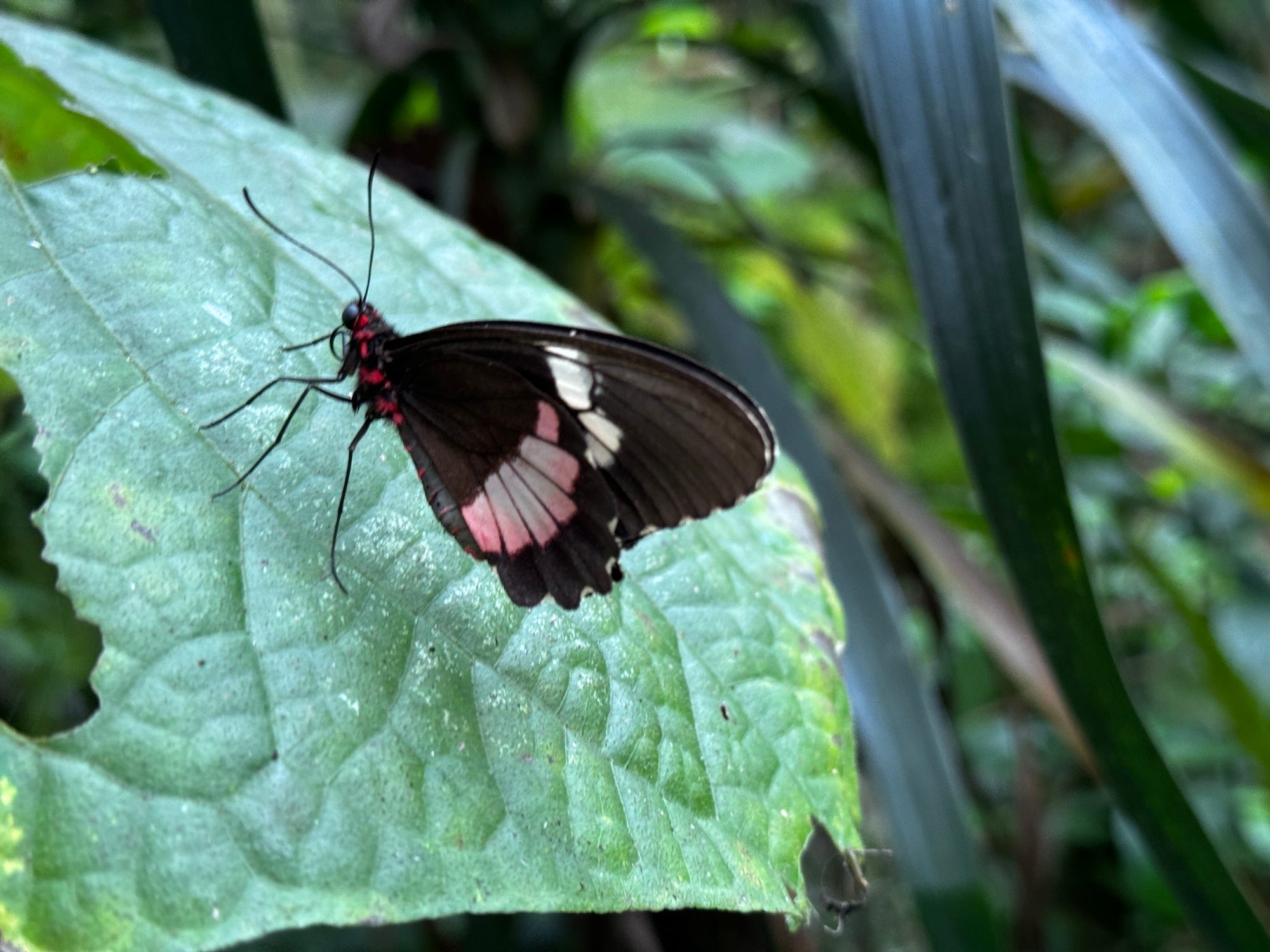
Not a monarch, but a butterfly that let me get close enough to take a pic (Photo: Christine Sarkis)